Pre-2025 Me
July 27, 2026
This is a look back at the work that occupied me before 2025. Broadly, I have been interested in the principles governing the function of the primate visual and visuomotor system. Below are the projects I worked on — much of it in collaboration with other experimentalists and theorists, whom I name where relevant.
Cortico-cerebellar circuits for eye movement control (2011–2016)
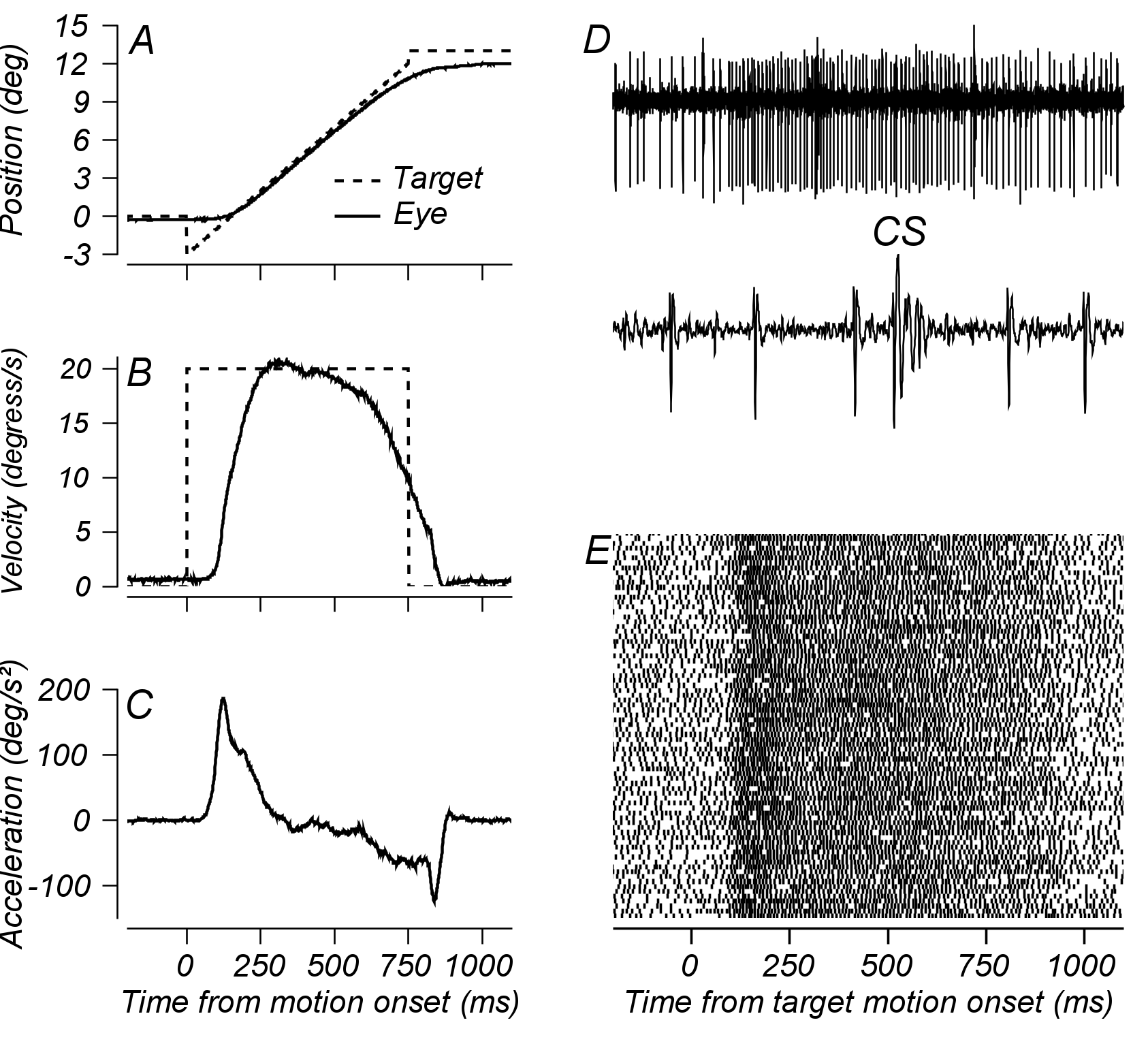 A Purkinje cell’s response in the oculomotor vermis during pursuit eye movements. A–C: averages of eye and target position, velocity, and acceleration vs. time for step-ramp target motion. Dashed and solid lines show target and eye kinematics, respectively. D: extracellular potentials from a Purkinje cell on slow and fast time base, showing both simple spikes and 1 complex spike (labeled CS). E: raster showing simple-spike times during 100 repetitions of the same target motion and pursuit eye movement. Raghavan and Lisberger 2017
Publications
- Raghavan, R.T., and Joshua, M. (2017). Dissecting patterns of preparatory activity in the frontal eye fields during pursuit target selection. J Neurophysiol 118, 2216–2231. doi.
- Raghavan, R.T., and Lisberger, S.G. (2017). Responses of Purkinje cells in the oculomotor vermis of monkeys during smooth pursuit eye movements and saccades: comparison with floccular complex. J Neurophysiol 118, 986–1001. doi.
- Raghavan, R.T., Prevosto, V., and Sommer, M.A. (2016). Contribution of Cerebellar Loops to Action Timing. Curr Opin Behav Sci 8, 28–34. doi.
Conference proceedings
- Raghavan R.T., Lisberger S.G. (2015). Differences between Purkinje cell responses in floccular complex and oculomotor vermis during pursuit eye movements. Gordon Research Conference: Cerebellum.
- Raghavan R.T., Prevosto V., Darie R., Sommer M.A. (2013). Timing activity in the lateral cerebellum. Society for Neuroscience Abstract 647.01.
Efficiency of cortical representations
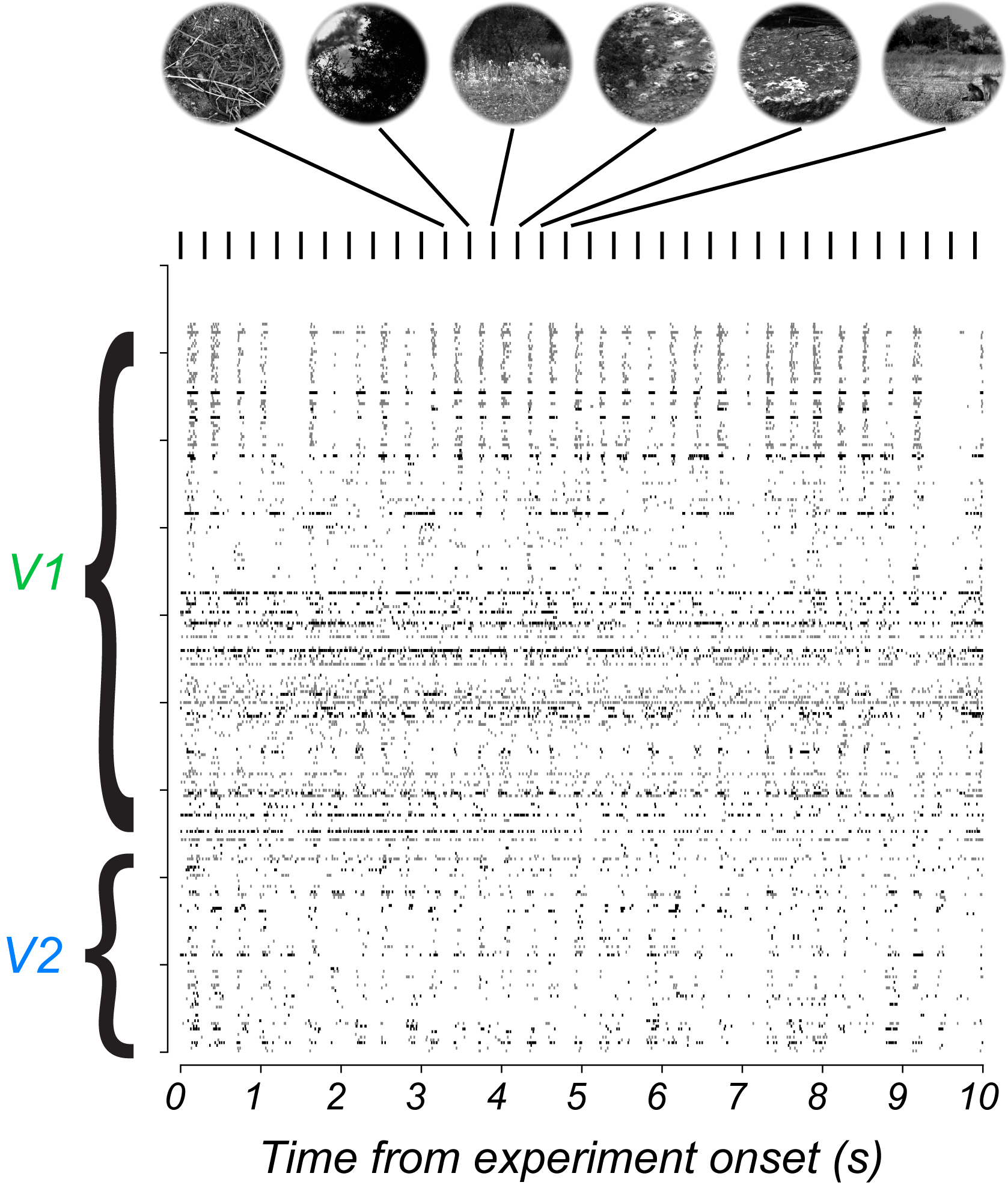
Response of a population of monkey V1/V2 cells to rapid serial visual presentation of natural images. Neurons were recorded using a neuropixels array traversing V1 and V2. A normative theory of efficient coding (Ganguli and Simoncelli 2014) predicts that the average firing rate of all V1/V2 cells is constant across a large corpus of natural images.
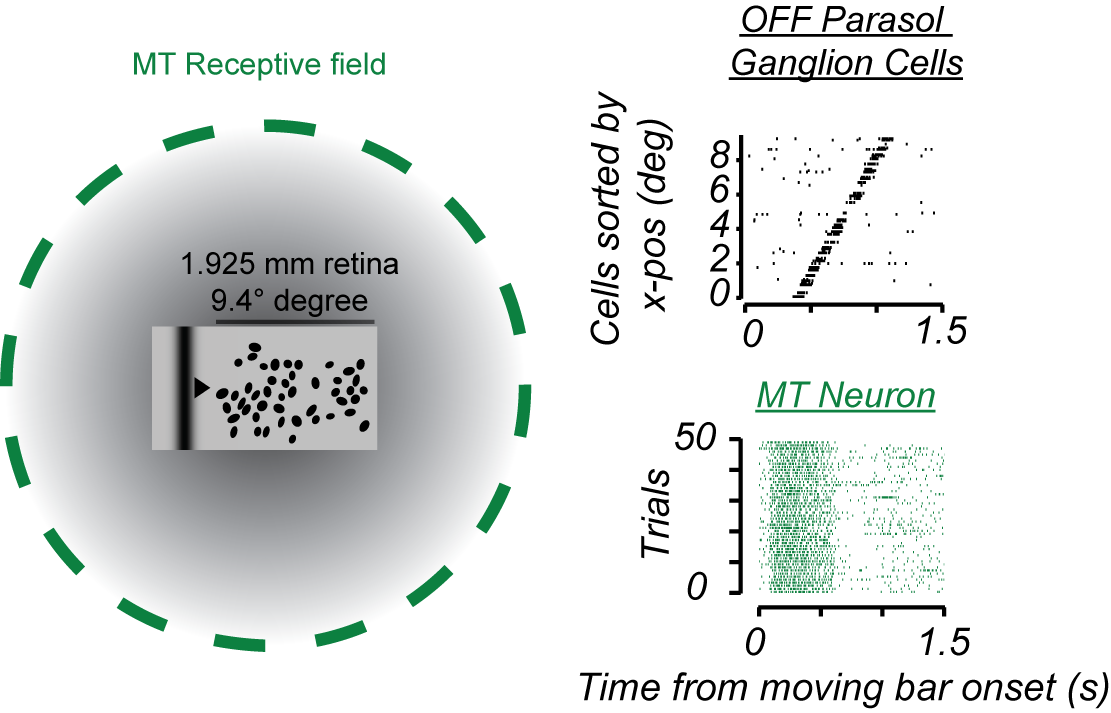
Recordings from retinal ganglion cells and single MT neurons in the monkey in response to the same stimulus. Receptive field of the MT neuron chosen to cover a population of retinal cells. Stimulus is a Gaussian-edged bar drifting within the center of the MT receptive field and across the receptive fields of 64 OFF parasol ganglion cells that feed it.
Conference proceedings
- Raghavan R.T., Movshon J.A., Chichilnisky E.J. Decoding of retinal motion signals by neurons in macaque cortical area MT. FASEB Retinal Neurobiology and Visual Processing Conference 2022.
- Representation of natural scene statistics in the monkey’s early visual cortex (Talk @ COSYNE 2022). Brainscore workshop.
- Raghavan, R.T., Movshon, J.A., and Chichilnisky, E.J. (2019). Decoding of retinal motion signals by cells in macaque MT. Journal of Vision 19, 165b–165b. doi.